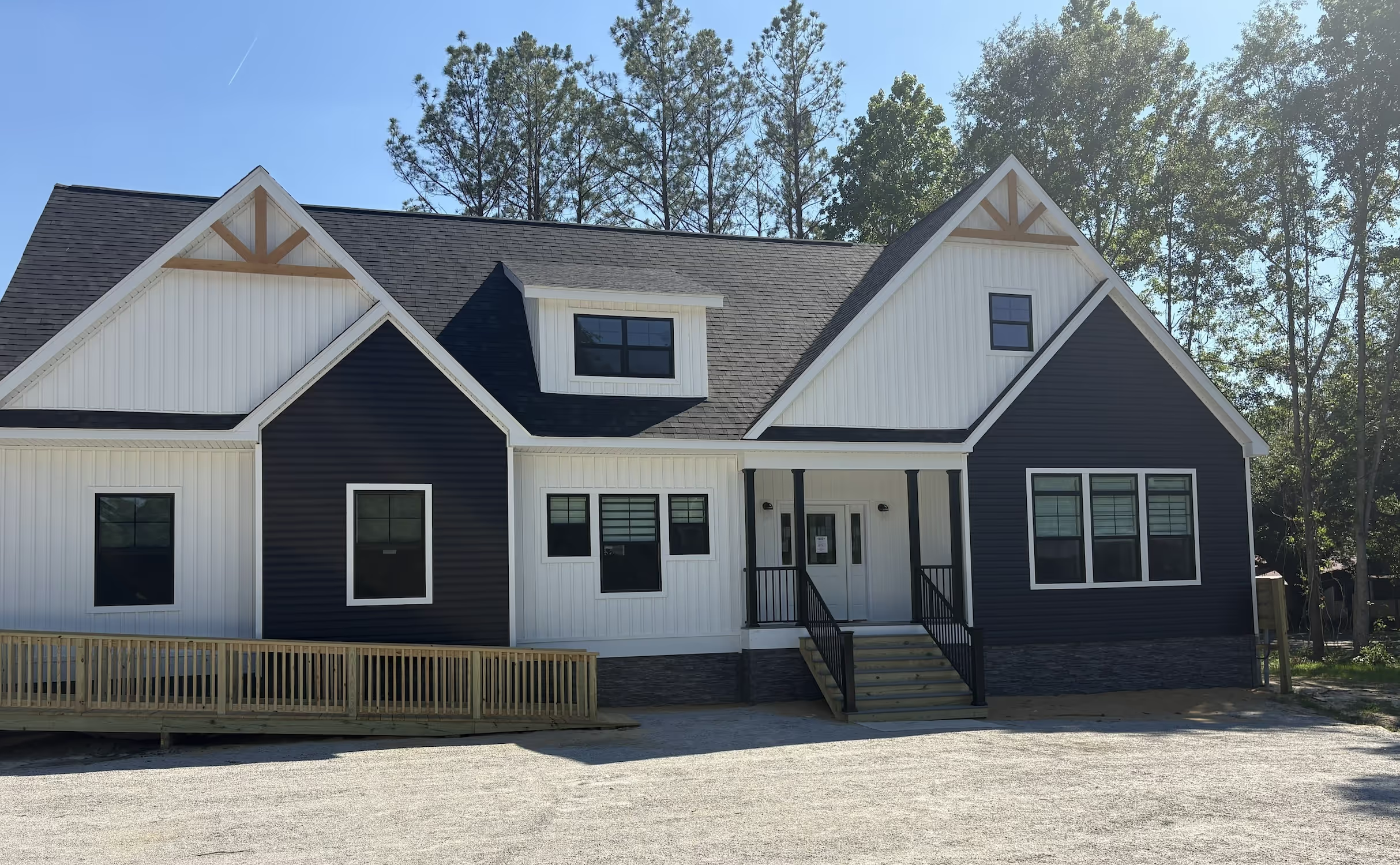
New Yemassee, SC display center now open!
Learn More
November 5, 2026
This guide walks through the main loan programs our South Carolina modular home buyers in Lancaster, York, Union, and Kershaw counties use: USDA rural development loans, FHA loans, VA loans, and construction-to-permanent financing, along with the pitfalls to avoid.

A modular home loan isn't the same paperwork you'd sign for an existing house down the street, and that surprises many first-time buyers. Some lenders handle modular financing every week. Others rarely see it, and that gap can slow or even derail a sale if you don't know what to ask for. This guide walks through the main loan programs our South Carolina modular home buyers in Lancaster, York, Union, and Kershaw counties use: USDA rural development loans, FHA loans, VA loans, and construction-to-permanent financing, along with the pitfalls to avoid.
Financing a modular home differs mainly in the details lenders check, not in the loan programs themselves. FHA, VA, USDA, and conventional loans all cover modular homes on a permanent foundation, per FHA Title II guidelines (HUD.gov, 2026). The catch is that not every loan officer has closed one before.
Here's the thing: once a modular home is set on its permanent foundation and finished, it's treated like real property for lending purposes, not personal property. The Modular Building Institute, the industry's trade association, notes that a completed modular home is legally and physically indistinguishable from a site-built house once it's placed (Modular Building Institute, 2026). That's a meaningful distinction from a manufactured or mobile home, which is often titled differently and can face tighter financing terms. For a full breakdown of what that means for your budget, see our guide on modular home costs.
Where things get tricky is timing. Because a modular home is built in phases (factory construction, delivery, site work, final inspection), the loan often has to account for a construction period before it converts to a permanent mortgage. That's where construction-to-permanent loans come in, which we'll cover further down.
A USDA modular home loan requires no down payment for eligible borrowers building in a designated rural area and is backed by the U.S. Department of Agriculture (USDA Rural Development, 2026). Much of CCH's service area in Lancaster, Union, and Kershaw counties falls within USDA-eligible zones. That's a big reason this program comes up so often with our buyers.
USDA loans are need-based and location-based rather than purely credit-based. Eligibility depends on two things: household income must stay under a county-specific limit, and the property must be in an area USDA classifies as rural.
In most counties, household income can’t exceed $122,800 for a 1-4 person household or $162,100 for a 5-8 person household. In some areas, those limits can be higher in the Charlotte, Charleston, and Beaufort metro areas.
You can check current property eligibility directly on the USDA's eligibility map before you get too far into planning.
We've found that buyers who are new to the process assume USDA loans are only for farms or large acreage. That's not accurate. A USDA rural development loan SC buyers use most often is a standard home loan for a modest lot in a qualifying rural or semi-rural area, which describes a lot of the land around Lancaster and York counties.
One trade-off worth knowing: USDA loans typically require the home to be new construction or nearly new. It must also go through a USDA-approved appraisal process specific to modular homes. Not every appraiser is familiar with that process, so ask your lender who they use.
Yes, an FHA modular home loan is available through FHA's Title II program, which covers homes permanently attached to a foundation on land the borrower owns or is purchasing (HUD.gov, 2026). FHA loans are popular because they allow lower credit scores and smaller down payments than many conventional programs.
The permanent foundation requirement is non-negotiable for FHA. The home has to meet HUD's foundation standards. On top of that, the manufacturer's data plate and certification label need to be intact and verifiable at closing. We've seen closings get delayed because a lender's appraiser wasn't sure what to look for on a modular home's certification label. It pays to ask your lender upfront if they've closed modular loans before.
FHA loans also require the home to be classified as real property. That means you must remove any wheels, axles, and towing hitch used to transport the modular sections after placement. This is standard practice for CCH homes, but it's worth confirming with your lender to avoid confusion during the appraisal.
A VA loan modular home purchase can qualify for zero-down-payment financing for eligible veterans, active-duty service members, and some surviving spouses, guaranteed in part by the U.S. Department of Veterans Affairs (VA.gov, 2026). Like FHA, the VA requires the modular home to be affixed to a permanent foundation and titled as real estate.
Veterans need a Certificate of Eligibility (COE) before a lender can process the loan.
The property must also meet VA minimum property requirements. These cover things like water and sewer access, structural soundness, and safe egress, standards a modular home built to code generally meets without extra work.
Do VA loans cost more upfront than other programs? Not usually. Many veterans are surprised to learn the VA loan can be one of the more favorable options available for modular financing, since it often skips mortgage insurance that FHA and conventional loans require.
The Lender will use their own (normal) guidelines to determine the size of the loan you might qualify for. Not every lender chooses to provide VA loans.
A modular home construction loan covers the cost of the home and land during the build phase, then converts to a permanent mortgage once construction is finished and the home passes final inspection. This construction-to-permanent structure is the standard financing path for buyers who don't already own their land outright.
During the construction phase, the lender typically disburses funds in stages, tied to milestones like factory completion, delivery, and set. Interest during this period is usually charged only on the funds drawn so far, not the full loan amount. Once the home is complete and gets its certificate of occupancy, the loan rolls into a standard fixed or adjustable mortgage, and you avoid a second closing.
This loan structure makes sense if you're buying raw land and building at the same time. See our guide on land packages for how land purchase and home financing typically get bundled. If you already own your land free and clear, some of that complexity goes away, since the lender only needs to finance the home itself.
The single biggest pitfall is working with a lender who hasn't closed a modular loan before. Modular homes require specific appraisal comps, permanent foundation documentation, and certification paperwork. A lender unfamiliar with the process can misunderstand these details, sometimes leading to delays of several weeks or even a denied loan late in the process.
Another common issue: buyers assume modular homes appraise the same way manufactured homes do. They don't, but if an appraiser pulls the wrong comparable sales (manufactured or mobile homes instead of modular or site-built), the appraisal can come back lower than it should. In our experience, this mismatch is one of the most avoidable and most common reasons a modular financing timeline slips.
A permanent foundation isn't optional for FHA, VA, or USDA financing. If the foundation doesn't meet the applicable engineering and HUD standards, the loan simply won't close, no matter how strong the buyer's credit is. This is why site work planning has to happen early, not as an afterthought once the home is on order. Our guide to the modular home building process walks through when foundation and site work happen relative to the loan timeline.
Our team can introduce you to lenders who've specifically closed USDA, FHA, VA, and construction-to-permanent loans on modular homes in our market. That familiarity matters more than most buyers expect, since a lender who already understands appraisal and foundation requirements moves faster and avoids surprises.
We don't handle the loan itself, and we're not going to pretend to be mortgage experts. What we can do is point you toward lenders we've seen work well with modular buyers before. We'll also flag the documentation you'll likely need early, things like the manufacturer's certification, foundation plans, and site evaluation reports. Getting those lined up before you apply tends to make the whole process smoother.
If you're still deciding whether land or land-and-home financing makes more sense for your situation, that's a conversation worth having with our team before you talk to a lender.
Can I get a USDA loan for a modular home in South Carolina?
Yes, if the property is in a USDA-eligible rural area and you meet the income requirements for your county. Much of CCH's Lancaster, Union, and Kershaw county service area qualifies, though eligibility varies by address (USDA Rural Development, 2026).
Do modular homes qualify for a 30-year mortgage?
Yes. Once a modular home is complete, permanently affixed to its foundation, and passes final inspection, it typically qualifies for standard fixed-rate mortgage terms, including 30-year loans, the same as a site-built home.
Is it harder to get approved for a modular home loan than a regular mortgage?
Not inherently harder, but it does require a lender familiar with modular-specific requirements like foundation certification and appropriate appraisal comparables. Choosing an experienced lender is usually the biggest factor in a smooth approval.
Can I use a construction loan if I already own my land?
Yes. If you own the land outright, the construction loan only needs to cover the home build itself, which can simplify underwriting compared to financing land and home together.
Carolina Country Homes has two showrooms. Our Lancaster location is open six days a week, and our new Yemassee showroom is now open for the Lowcountry. Come walk through display homes from four manufacturers, or schedule a free virtual meeting with our team if you're not local yet.
Building a modular home with Carolina Country Homes is an exciting and rewarding experience, from the initial display center visit to the day you move into your beautifully crafted new home. Reach out for more information about our Custom Built Homes!